Disclosure: Some links on this page are affiliate links. We may earn a commission if you purchase through them — at no extra cost to you. Read our full affiliate disclosure.
Browse & Compare AI Tools
Browse, filter and discover the best AI tools across every category.
218 tools
Trending:
Pricing
Access
Status
Sort
218 results
Cols
B
Bluedot
#257New
Writing & Copywriting
Bluedot is a privacy-first, “invisible” AI notetaker and meeting intelligence platform. Instead of sending a bot into the call as a visible participant, it captures meetings from the user’s own device — via Chrome extension, macOS/Windows desktop app, iOS/Android phone or tablet, and even Apple Watch. That makes it especially attractive for sales calls, recruiter screens, board meetings, client check-ins, and in-person interviews where a recording bot would change the tone of the conversation.
Anyword = an LLM-agnostic conversion-prediction layer for marketing copy: generates ad headlines / email subjects / LP sections / SMS / product blurbs / blog drafts, then scores every variant 0–100 on predicted CTR+conversion with demographic + emotion panels
ChatGPT (OpenAI, San Francisco; launched Nov 2022, 800M+ WAU / ~1.2B MAU est. 2026) = the generalist AI surface — chat + GPT-5.6 Sol/Terra/Luna routing + Codex agent + ChatGPT Work + Deep Research + Images 2.0 + Voice (GPT-Live-1) + Memory/Projects/Custom GPTs + 60+ connectors. Not Claude (writing/coding-first), not Gemini (Workspace-native), not Perplexity (cite-first).
Claude (Anthropic, San Francisco; public Mar 2023, Fable 5 / Opus 5 / Sonnet 5 / Haiku 4.5 lineup 2026) = the writing-/coding-/long-doc-safe generalist built on Constitutional AI — chat + Claude Code + Claude Cowork + Artifacts + Projects + Research + 60+ connectors (Gmail/Drive/Slack/M365/GB). Not ChatGPT (broader multimodal/ecosystem), not Gemini (Workspace-native), not Character.AI (RP).
Copy.ai (Memphis, 2020; Paul Yacoubian + Chris Lu; 10M+ users; acquired into Fullcast RevOps suite 2025) = the ex-copywriter that pivoted to a GTM AI platform — 90+ short-form templates + multi-model Chat (GPT-5/Claude/Gemini) + Brand Voice + Infobase, wrapped in a no-code Workflow Builder and Copy Agents that pull a lead from HubSpot, enrich, draft 20–30 email variants, and push to Outreach/Salesloft. Not ChatGPT (general), not Jasper (brand-voice long-form), not Clay (enrichment-first).
Not shut down. Frase (founded ~2018, Boston-based) is active as of 2026-08, repositioned from "AI SEO brief generator" into an agentic SEO+GEO content platform (Frase Agent, 80+ skills, Content Guard, AI Visibility across ChatGPT/Perplexity/Claude/Gemini/Google AI). Old Solo/Basic/Team tiers retired; 2026 sells Starter/Professional/Scale + custom Enterprise. 7-day no-card trial, no perpetual free plan. Category ai-productivity-data; pipeline_stage none. Killer differentiator = folds SERP research + brief + AI draft + dual SEO/GEO score + AI-answer citation tracking + decay-watch auto-revision into one workspace; not Surfer (deeper on-page scoring, weaker AI writing), not Clearscope (enterprise editorial, no agent/auto-publish), not NeuronWriter (cheaper LTD, shallower GEO), not Jasper/Copy.ai (pure AI copy, no SERP optimization). 2026 trap: all tiers meter articles + audit pages + AI-visibility prompts; Starter hard-stops at 10 articles/mo; Rank-Ready one-offs $3.50 each; AI drafts still need human fact-check.
HyperWrite = writing co-pilot that lives in your tabs: install Chrome ext → type in Gmail/Docs/LinkedIn → TypeAhead finishes sentences (Tab to accept, learns your voice) → AutoWrite/Summarizer/Rewriter/Email Responder in web app → HyperChat with Exa-style web pull + Scholar AI peer-reviewed citations → Personal Assistant takes over the tab to fill forms/book/scrape 5 competitor prices → 3–10 Custom Personas (Professional/Casual/Academic) shape tone. Fits ai-productivity-data; pipeline_stage none (type→complete→draft→cite→agent-act). For email-heavy knowledge workers, students writing cited papers, job seekers tailoring apps, and anyone whose day is 20 browser tabs, it removes copy-paste-to-ChatGPT fatigue; for team brand-voice/SEO/multilingual, Jasper/Copy.ai/Writesonic win.
Jasper = the marketing-content OS with brand memory: start 7-day trial → load 10+ brand docs into Jasper IQ → train 2 Brand Voices (Pro) / unlimited (Business) + 5 Knowledge assets (product specs, style guide) + 3 Audiences → open Canvas to draft blog→email→landing→ad from one campaign brief, or Jasper Chat (web-grounded, brand-aware) → Essential Agents run core workflows (SEO brief, email nurture, social batch) → image suite generates/edits visuals (remove bg, upscale, uncrop) → Business adds Advanced Agents, Jasper Grid (batch 1,000s of rows), no-code AI App Builder, API + MCP, SSO/SCIM, Groups → connect WordPress/HubSpot/Surfer/Asana. Fits ai-productivity-data; pipeline_stage none (brief→brand-ground→draft→multi-channel→govern→ship). For 5+ person marketing teams, agencies, and brand-sensitive orgs shipping 10k+ words/mo, it pays; for solo bloggers, ChatGPT Plus + a Custom GPT is 1/3 the price.
Jenni AI = the cited drafting desk for researchers: open jenni.ai editor → upload 10 PDFs (Free) / unlimited (Plus-Pro) or import Zotero/Mendeley → autocomplete suggests next sentence drawing only from your library + 248M index → inline insert APA/MLA/Chicago/IEEE/Vancouver citation → AI Chat answers "what do Seitz 2014 and Kim 2026 disagree on" with page links → Section Prompts steer intro/methods/discussion → Reviews scans every claim across 6 categories (unsupported/contradicted/overstated/weakly-supported/misrepresented/proofread) → export .docx/.tex/.html + .ris/.bib. Fits ai-productivity-data; pipeline_stage none (upload→ground→draft→cite→review→export). For grad students/thesis/dissertation/literature-review writers, it removes the Scholar-tab-switch tax; for marketing/SEO/fiction, it's the wrong tool.
Notion AI = the teammate that already lives in your docs, not a chatbot you alt-tab to: type /ai or Space on a blank line → draft/summarize/translate/improve selection in-page (AI Core, trial on Free/Plus, full on Business) → open Notion Agent (bottom-corner face) to "scan Jira epics + Slack thread + Drive brief, draft Q3 OKR page, assign owners, schedule pre-read" multi-step → enable AI Meeting Notes to transcribe Zoom/Meet, pull decisions + action items into a Notion page → flip on Enterprise Search to ask "what did we decide about pricing in Slack last month + the Drive memo?" with citations across Slack/Drive/Jira/GitHub/Box/Salesforce → build Custom Agents (9am patrol: yesterday's issues → Slack summary; Monday: customer Qs → FAQ db) on schedules/triggers, burning Notion credits → Research Mode (beta) compiles long reports from workspace+web. Fits ai-productivity-data; pipeline_stage none (prompt→ground→draft→agent→automate). For teams whose wiki/tasks/meeting notes already live in Notion, Business $20/seat is the contextual multiplier; for general reasoning/coding/creative, ChatGPT/Claude still win.
Peppertype = the 2021–2023 mid-market template drawer: pick "Facebook ad" → paste product name → get 10 variants in 30s, tune brand voice, push to Pepper Docs, schedule via Buffer. Fine for social/ad/email volume when ChatGPT didn't exist; by 2026 the standalone job is done by ChatGPT Plus $20, Jasper, Copy.ai, Writesonic. Now survives only as the "Pepper AI / AI Content Studio" generator inside pepper.inc's enterprise bundle (Atlas SEO/GEO + human writer marketplace + Pepper Docs).
ProWritingAid is "Grammarly for people who actually want to learn to write." Beyond correctness it runs 25+ analytical reports on style, structure, readability, repetition, sentence-length variation, clichés, diction, consistency, and fiction-specific signals (dialogue tags, pacing, POV drift), each with an explainer so the writer improves rather than just accepts a redline. 2024–26 it added AI layers — Rephrases (tone/distance rewrites), Sparks (expand/summarize/continue), Chapter Critique (developmental AI feedback per chapter), Manuscript Analysis / Virtual Beta Reader (Story Credits, metered), and document-type goals (fiction/academic/business). It edits where you write: MS Word, Google Docs, Scrivener (native, the killer integration), Outlook, Chrome/Firefox/Safari/Edge, macOS/Win desktop. Plagiarism is not in base Premium — it's a separate credit pack (or bundled 50/yr in old "Premium+" / metered in Premium Pro). English only (US/UK/AU/CA variants).
QuillBot = the rewrite bench, not the draft desk: paste a paragraph into quillbot.com or the Chrome/Edge/Safari extension or Word add-in → Paraphraser rewrites with synonym slider + mode pick (Formal for memos, Academic for papers, Creative for blogs, Shorten/Expand for length control) in 23 langs → Grammar Checker fixes in 6 langs (EN US/UK/CA/AU, DE, FR, ES, PT-BR, NL) → Summarizer condenses 6,000 words (Premium) to bullets/paragraphs → Translator 40+ langs → Citation Generator (APA/MLA/Chicago/Harvard from URL/DOI) → AI Humanizer (machine text → "human score" + tone insights) + AI Detector (text + image) + Plagiarism Checker (25k words/mo Premium) → QuillBot Flow (doc editor, 100MB Premium) + AI Chat (20 free/∞ Premium) + AI Image (3 free/300 Premium) + PDF tools (ChatPDF/merge/split/convert). Fits ai-productivity-data; pipeline_stage none (paste→paraphrase→grammar→summarize→cite→humanize). For students/academics/ESL/agencies refactoring existing copy, it's the cheapest serious seat; for zero-draft generation, ChatGPT/Claude.
Sudowrite = a fiction-only AI writing copilot (web editor + iOS/Android apps) that pairs a proprietary fiction-trained model (Muse) with Story Bible continuity tracking and inline tools — Write / Describe / Expand / Rewrite / Brainstorm / Feedback / Canvas / Visualize — to draft, enrich, and revise novels and screenplays in the author's voice. It suggests; the human accepts or deletes. Credit-metered subscription, no public API, no non-fiction mode.
Wordtune highlights a sentence (or paragraph) in Gmail, Google Docs, LinkedIn, Slack web, or its own editor and returns multiple rewrites filtered by Casual / Formal / Shorten / Expand, each preserving meaning but shifting register. Underneath: AI21 Jamba/Instruct family + heuristic alignment, not a chatbot. Wordtune Spices injects examples, statistics, counterarguments, transitions; Wordtune Read summarizes URLs/PDFs/YouTube transcripts to bullets with follow-up Q&A. It is the "I wrote it, make it sound human" layer — stronger than Grammarly on natural rephrase, weaker than QuillBot on bulk paraphrasing modes, not a substitute for Grammarly's error-catching or ChatGPT's open drafting.
Writesonic is an AI-powered content + AI search visibility platform: Chatsonic (web-access chat, GPT-4o / Claude 3.7 / Flux) researches in real time; Article Writer 6.0 drafts 1.5k–6k-word SEO articles grounded in 100+ SERP sources with auto fact-check + EEAT signals; the GEO suite (Brand Presence & Prompt Explorer) then tracks your brand across ChatGPT / Gemini / Google AI Overviews / Perplexity / Claude / Copilot and funnels fixes into the Action Center. Built to close the loop — write, optimize, track, fix — not just monitor.
Creatify AI is an AI-native video-ad platform built for e-commerce brands, DTC sellers, agencies, and performance marketers. You paste a Shopify, Amazon, or app-product URL (or upload an image / brief), and Creatify scrapes the product, writes ad scripts, picks a realistic AI actor or UGC avatar, adds voiceover, music, and captions, then renders multiple 9:16 / 1:1 / 16:9 ad variants ready to test on Meta, TikTok, YouTube, Snap, and AppLovin. Unlike faceless-shorts tools (InReels) or localization/avatar platforms (HeyGen), Creatify is obsessed with the paid-media loop: generate → clone winning ads → track competitors → launch → read ROAS/CTR → regenerate. Its differentiators are URL-to-video, batch variation (up to ~50 at once), Ad Cloner, Competitor Ad Tracker (10M+ Meta ads), Performance Agent, Ad Launcher, MCP for Claude/ChatGPT, and a credit-metered API for programmatic ad factories.
InReels AI is an all-in-one, vertical-first AI content platform for short-form video. You describe an idea, paste a product URL, or upload a product photo, and it generates a finished Reel/TikTok/YouTube Short-style video with AI script, voiceover, captions, music, avatars, and effects — usually in 2–3 minutes. It covers two big use cases at once: organic faceless content (Reddit stories, horror, brainrot, educational shorts) and AI UGC / product video ads (avatar spokespersons, product-in-hand compositing, cinematic product ads). Unlike pure video-model playgrounds such as Pika or Runway, InReels is positioned as a “content pipeline,” not just a clip generator: higher-tier plans add automation series, scheduled/auto-posted content, and commercial usage. The pitch is simple: solopreneurs, dropshippers, and small DTC brands can replace five tools (image gen, script writer, voiceover, editor, scheduler) with one affordable workspace.
KreadoAI is an all-in-one AIGC content platform built for global / cross-border marketing, e-commerce, training, and multilingual video production. Instead of hiring voiceover artists, spokespersons, translators, and video editors, a team can log into KreadoAI, paste a product URL / PPT / PDF / script / image, pick one of 1,000+ AI avatars and 40,000+ voices across 140+ languages, and generate a finished spokesperson video in minutes.
Its core strength is “write once, localize everywhere.” A single English script can become a Mandarin spokesperson ad, a Spanish TikTok reel, an Arabic product demo, and a Japanese e-learning clip — with voice cloning, avatar cloning, and lip-synced video translation keeping the brand voice consistent across markets. Beyond avatar videos, KreadoAI also covers talking-photo videos, AI fashion/models for e-commerce, digital-human livestream shopping hosts, AI scripts, AI images, background removal, face swap, subtitle/watermark removal, and multi-size ad creatives, making it closer to a multilingual commerce-video studio than a simple text-to-video tool.
Pricing runs on a K-coin system: Free gives a small trial pack, Premium starts around $19/mo, Pro around $40/mo with API + voice/avatar clones, and Enterprise adds private deployment and SLAs. Reviewers generally praise its language coverage, URL-to-video speed, and e-commerce integrations (Shopify / SHOPLINE / Shoplazza-style stores), while critics point to opaque credit math, templated gestures, and weaker lip-sync in rare languages versus HeyGen / Synthesia.
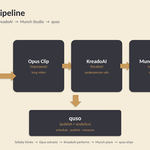
Syllaby (https://syllaby.io) is an end-to-end “faceless content operating system” for creators, coaches, realtors, local businesses, and small agencies who know they should post on TikTok, Instagram, YouTube, and LinkedIn — but don’t want to be on camera, don’t know what to say, and don’t have an editor. Instead of starting from a finished video like Opus Clip or Vidyo.ai, Syllaby starts from intent: it researches what your audience is searching (questions, keywords, trends, CPC signals), turns those into hook-driven scripts and blog/linkedin/caption drafts, then generates faceless short videos using stock/B-roll scenes, AI avatars / Digital Twin presenters, and cloned voices. From there it behaves like a mini social media department — auto-captions, AI thumbnails, a content calendar, and bulk scheduling to TikTok, Reels, Shorts, LinkedIn, Facebook, and YouTube. Under the hood it plugs into modern generative models (Sora 2, Google Veo 3, Seedance, etc. depending on plan), offers voice cloning and custom avatars on mid/high tiers, ships iOS/Android apps, and has begun exposing an API + MCP server for Claude/Cursor workflows. Pricing starts at 9/mo(Starter)∗∗andscalesto∗∗29 Basic / 78Standard/153 Premium, with credits consumed per video/script/idea rather than flat unlimited — which is why reviewers love its pipeline (“idea → script → faceless video → scheduled post in one login”) but warn that the credit math gets expensive at agency volume. In short: Opus Clip repurposes what you already recorded, HeyGen perfects avatars, Pictory converts text into video — Syllaby sits earlier in the funnel and answers “what should I even post, and can I ship it without showing my face.”
Turns podcasts, webinars, YouTube videos, and interviews into captioned short clips, then schedules/publishes them across TikTok, Reels, Shorts, LinkedIn, Facebook, X, and Pinterest from one dashboard.
Munch is a strong “long video → social clips” tool, especially for podcasts, webinars, and interviews. Rate it ~3.5–4.6/5 depending on source: great time-saver, but priced for teams, not casual creators, and weaker on deep editing + billing experience.
AdCreative.ai is an AI ad creative platform founded in 2021 and acquired by Appier in 2025. It is not a general-purpose design tool (distinct from Canva or Firefly), but an ad creative production engine purpose-built for performance advertisers, DTC brands, and agencies. Its core selling point is "generated creatives come with a conversion prediction score" — the model is trained on 1B+ ad creatives generated on the platform combined with real-world ad performance data.
Adobe Firefly — Full Introduction (2026, Adobe Inc.) Adobe Firefly is Adobe's commercially-safe generative AI suite for images, video, vectors, and audio, launched in beta March 2023 and now sitting across the Creative Cloud ecosystem. Its defining position is training data: Firefly's own models are trained exclusively on licensed Adobe Stock, public-domain works, and openly…
Ahrefs — Full Introduction (2026, Ahrefs Inc. / Singapore + Palo Alto) 1. One-line positioning Founded in 2011 and operating out of Singapore and Palo Alto, Ahrefs was created by Dmytro Gerasymenko, while Tim Soulo acts as the platform’s primary public‑facing representative. Long‑established as the incumbent backlink‑index tool, it has since expanded into an end‑to‑end…
AIVA is "the AI composer that hands back an editable score, not just a rendered track." No lyrics, no vocals: you choose from 250+ style presets (Modern Cinematic, Symphonic, Chinese, Jazz, Ambient, Electronic, Tango…) or upload a reference MIDI/audio to train a custom style model, set key/tempo/length/emotion, and it composes a full multi-section arrangement. The built-in editor shows piano-roll score — move a note, change velocity, re-voice the brass, swap instruments — then export MIDI to finish in Logic/Cubase/Pro Tools, or WAV+STEMS on Pro for direct-to-media. 2017 it became the first AI registered as a composer by SACEM, which is why its copyright ladder (Free→Standard→Pro) reads like a music-publishing contract, not a SaaS EULA. Pitch: Suno writes the sung single; AIVA drafts the film/game score you own and can re-orchestrate by hand.
Akool = Palo Alto enterprise AI video suite (founded 2021/2022 by Dr. Jiajun "Jeff" Lu, ex-Apple Face ID / Google Cloud video, #1 on Inc. 5000 2025, 10M+ users / 73K+ companies / 300M+ assets, Coca-Cola + Qatar Airways + Canon + Logitech + AWS + Google Cloud as customers) that bundles AI avatar video, real-time streaming avatars, face swap up to 16K, video translation in 155+ languages with diffusion lip-sync, talking photo, voice clone, text/image/reference-to-video, PPT-to-video, and holographic event display — all behind one pooled credit meter and a REST API (x-api-key). Free 720p/5-min watermark; Pro $21/mo annual ($30 monthly, 600 cr); Pro Max $79/mo annual ($119 monthly, 1,200 cr, API); Business $350/mo annual ($500 monthly, 6,000 cr, Studio Avatar, commercial license); Enterprise custom with non-expiring credits. It is the breadth + face-swap + live-interaction bench — distinct from HeyGen (script-to-presenter realism, 175 langs, SCORM), Synthesia (L&D-only), and Runway/Kling/Veo (pure footage, no avatar product).
Amazon Q Developer is in sunset — not shut down yet, but AWS closed new signups 2026-05-15 and will end support for IDE plugins + paid subscriptions on 2027-04-30 (successor = Kiro). Per your rule ("if closed, warn and do not output intro"), I warn: not outputting full English introduction body, but giving the rest in table form with status flag upfront.
Headquartered in Prague, Czech Republic, Apify Technologies s.r.o. was founded in 2015 by Jan Curn and Jakub Balada, participants of the 2015/2016 YC Fellowship program. The company operates with a VC-independent leaning while retaining formal VC backing. Prior to its first institutional financing, Apify achieved profitability through a bootstrapped operation model. It secured a €2.8M funding round in April 2024 led by J&T Ventures and Reflex Capital, with total capital raised reaching approximately $4.5M per Simplify data. As a YC alumni with limited venture funding, Apify remains unacquired, non-public, non-nonprofit, and is not classified as a Big Tech platform primitive. It falls into the VC-independent vendor bucket alongside n8n, Databox, Typeform and Documenso, clearly separated from pure bootstrapped players including Todoist and QuickChart. Apify provides a stable, official first-party GA MCP server hosted at mcp.apify.com, adopting OAuth streamable-HTTP transport while discontinuing SSE support as of April 2026. Its official open-source MIT-licensed MCP server @apify/actors-mcp-server holds 3.7K to 4.8K GitHub stars, unlocking a massive tool ecosystem of 26K–30K Apify Actors available for agent invocation. Ecosystem-wise, Apify joins the top-tier stable first-party GA server cluster with Klaviyo, Feedly, Slack, Databox and Tavily. It is differentiated from n8n dual-GA architecture, Google Sheets/Gmail first-party preview stack, Typeform beta-grade MCP, Nanonets Composio-exclusive integration model, and the zero-first-party MCP cohort covering Documenso, QuickChart, Semantic Scholar and Zotero.
Auphonic (Auphonic GmbH, Austria 2012/2013) Status: Active (founded 2012/2013 by Hans-Jürgen Schüler et al., Graz; 2 hrs free/mo permanent; 2026-01 RMS-based loudness for Audible/ACX, 2025-12 Denoising Editor; auphonic.com + API + CLI live 2026-09). Category ai-productivity-data; pipeline_stage=none. Not a podcast editor (→ Descript), not a live call denoiser (→ Krisp) — it is the broadcast-standard…
We use cookies for essential site functionality and, with your consent, for advertising and analytics. See our Cookie Policy.
Manage Cookie Preferences
Control each category of cookies separately. Essential cookies are always on to keep the site running.
EssentialRequired for core site functionality. Cannot be turned off.
AnalyticsAnonymous statistics about how visitors use the site, to help us improve content.
AdvertisingUsed to deliver and personalize ads (e.g. Google AdSense).
AffiliateRecords which page you entered an affiliate link from, for attribution. The links themselves always carry affiliate parameters and are not affected by this toggle.