
2026 AI Tool Buying Guide: Which Subscriptions to Renew, Which to Cancel Immediately
To be honest, the logic of purchasing AI tools in 2026 has completely changed compared to 2024. It’s not that there are fewer tools on the market. On the

Disclosure: Some links on this page are affiliate links. We may earn a commission if you purchase through them — at no extra cost to you.
To be honest, the logic of purchasing AI tools in 2026 has completely changed compared to 2024.
It’s not that there are fewer tools on the market. On the contrary, AI tools now shut down overnight, raise prices without notice, and get acquired all the time. You might sign up for an annual plan one month, only to find the product bought by Jasper and discontinued the next. I’ve seen at least a dozen such cases happen this year alone.
That’s why this guide is nothing like those generic “Top 50 AI Tools of the Year” lists you see everywhere. Most of those rankings are outdated within weeks, with broken links and obsolete recommendations that offer zero practical value for real practitioners.
This article is written exclusively for AI-powered operators: short-form creators, cross-border sellers, content matrix managers, and social media ad teams. No flashy feature demos, no empty rankings — only a practical, risk-focused buying framework to help you figure out which tools are worth long-term investment, which subscriptions to drop right away, and which ones to keep only as backups.
1. Introduction: The Core Shift in the 2026 AI Tool Market
New AI tools are launching nonstop, yet every single tool’s lifespan is getting shorter and shorter. Acquisitions, full shutdowns, core feature removals, and hidden price hikes have become the new normal in 2026.
The industry has been extremely volatile this year. Clipdrop was fully acquired by Jasper and stripped of many independent features. OpenAI discontinued the standalone Sora consumer product and merged its video generation capabilities into ChatGPT. The classic DALL·E 3 is officially retired, replaced by ChatGPT’s native image generation.
With constant market shakeups, traditional AI tool rankings are no longer reliable. Today’s “best tool” could be gone, rebranded, or more expensive tomorrow. Instead of chasing trending rankings, this guide focuses on three solid pillars: business stability, measurable ROI, and controllable risk.
Here are my non-negotiable golden rules for 2026 AI procurement: Never lock your workflow into a single model provider, avoid stacking too many third-party subscriptions, build in-house automations whenever possible, pay-as-you-go for video and AI human tools, and never commit to annual plans without rigorous risk and ROI verification.
2. Pre-Purchase Business Assessment: Map Your Workflow First, Buy Second
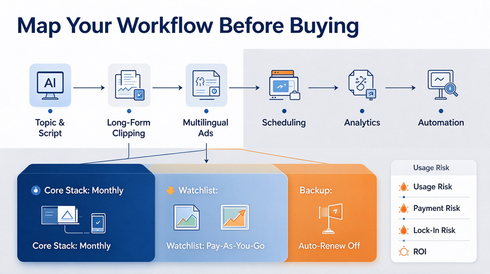
Most content and e-commerce teams make an incredibly costly mistake. They get attracted by flashy tool demos, subscribe on impulse, and then force their entire workflow to fit the tool. This mindless purchasing habit leaves most teams with a dozen overlapping subscriptions, massive budget waste, and constant workflow rebuilds every time a tool raises prices, gets acquired, or shuts down.
In the unstable 2026 AI market, no tool is forever reliable. The only budget-friendly, future-proof rule is simple: build your standardized business workflow first, then purchase tools to fill specific functional gaps. This pre-assessment approach eliminates blind spending, avoids dangerous vendor lock-in, and ensures every subscription directly boosts your content output, ad performance, and operational efficiency.
2.1 Build a Standardized Content & Ad Workflow Blueprint
Before testing or buying any AI tool, map out your full end-to-end operation pipeline. For cross-border e-commerce, short-form content matrices, and social ad teams, a mature, reusable standard workflow already exists. Every tool you pay for must fit a clear role in your pipeline — no redundancies, no overlaps.
2026 Standard Cross-Border Content & Ad Workflow:
Niche & Topic Research → Platform-Specific Script Writing → Long-Form Video Bulk Repurposing → Multilingual Ad Asset Generation → Content Scheduling & Publishing → Data Review & Optimization → Automated Workflow Standardization
Once your workflow is mapped, audit your current tool stack. Identify functional gaps, overlapping tools, and high-risk platforms you rely on too heavily. This single step can cut 30%–50% of your useless AI subscription costs immediately.
2.2 The 2026 Three-Tier AI Tool Classification System
Different tools require completely different purchasing strategies. Based on business dependency, operational risk, and replacement cost, categorize all your AI tools into three tiers before paying for anything:
Tier 1: Core Production Tool Stack
Mission-critical tools deeply integrated into your daily SOPs that directly determine your content throughput and ad performance. For core tools, stick to monthly subscriptions, conduct regular risk reviews, and always keep proven alternatives on standby. Never add untested, high-risk niche tools to your core stack.
Tier 2: Observation & Trial Tools
Tools with impressive features but high market uncertainty — fast model iterations, frequent pricing changes, acquisition rumors, and immature ecosystems. Use them only for innovation testing and auxiliary creation. Avoid fixed monthly or annual subscriptions entirely.
Tier 3: Backup Contingency Tools
Fallback solutions for core tool failures. Register and verify your accounts in advance, turn off auto-renew for all of them, and only top up credits or activate subscriptions when your primary tools shut down, spike in price, or suffer outages.
2.3 Four-Dimensional Risk & ROI Scoring Framework (Mandatory for All Purchases)
In 2026, “powerful features” mean nothing on their own. Controllable risk + measurable returns are the only valid purchasing criteria. Evaluate every tool across these four dimensions before subscribing:
1) Usage Risk (Vendor Stability)
Assess the chance of service disruption: sudden shutdowns, corporate acquisitions, core feature removals, and policy overhauls. Niche independent AI tools face extremely high elimination and acquisition risks, and big tech almost always strips core independent features after takeovers. Never build long-term dependency on high-risk tools.
2) Pricing Risk (Hidden Cost Fluctuations)
This is the most overlooked risk. Most vendors avoid direct price hikes and cut benefits silently instead: reduced monthly credits, expired unused quotas, forced watermarks on free plans, deleted projects after cancellation, and core features locked behind premium tiers. Always calculate the actual per-use cost instead of trusting sticker prices.
3) Business Lock-In Risk
Evaluate migration difficulty. Project data storage, custom workflows, team seats, and exclusive asset libraries all increase vendor lock-in. Any tool storing your core creativity, business data, or client information must support full data export. Otherwise, you face catastrophic operational paralysis if the tool fails.
4) Business ROI (Return on Investment)
Verify whether the monthly value generated by the tool far exceeds its subscription cost — including saved labor hours, higher content output, improved ad conversion rates, and reduced operational expenses. No matter how advanced a tool is, it is not worth paying for if it cannot boost revenue, efficiency, or production volume.
2.4 Non-Negotiable Cross-Border Compliance Baseline
For overseas-facing AI operations, compliance is a hard red line, not an optional bonus. Compliance failures lead directly to content takedowns, copyright disputes, GDPR violations, and banned ad accounts. Validate these four compliance standards before every purchase:
- Data Storage & GDPR Compliance: Confirm data storage locations to avoid EU user data violations
- AI Content Copyright Ownership: Ensure all generated videos, voiceovers, and creative assets are cleared for commercial ad use
- Training Data Privacy Rules: Prevent vendors from training public models using your uploaded product materials, ad creatives, and client data
- Asset Export & Migration Support: Guarantee full downloads of all project files, raw assets, and workflow data at any time
2.5 Ultimate Purchasing Principle
Never purchase any tool without a clear workflow position, verifiable risk score, backup alternative, and proven positive ROI.
This pre-evaluation system filters out 90% of hyped, useless, and high-risk AI tools on the 2026 market, ensuring your tool stack fully serves your business, resists market volatility, and keeps your budget under control.
3. 2026 In-Depth AI Tool Ratings & Reviews
3.1 ✅ Core Tool Stack: Business-Critical, Monthly Subscription Only
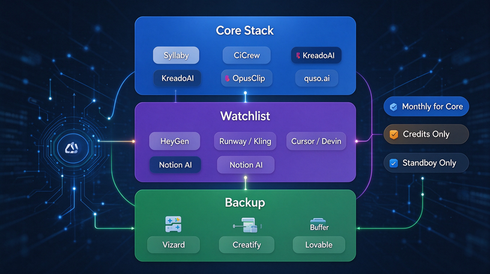
These tools are deeply embedded in daily production. Stick to monthly plans by default. Annual subscriptions are only allowed after two consecutive months of verified positive ROI and stable performance.
Syllaby — Niche Research & Script Writing
Still a stable go-to for social media content scripting in 2026. Input your niche and content direction, and it quickly generates platform-optimized script frameworks for TikTok, Instagram, YouTube, and more. It is not built for in-depth long-form industry analysis — delegate complex research to ChatGPT or Claude.
Usage Risk: Low
Pricing Risk: Moderate (Major general models keep closing the gap on social script generation, gradually weakening Syllaby’s competitive edge)
Purchase Strategy: Stick to basic/standard monthly plans; avoid overpriced enterprise annual packages entirely
Alternatives: ChatGPT + CapCut Manual Editing, Predis
CiCrew — No-Code System Building & Internal Tool Development
A dedicated AI workflow orchestration tool for teams. It lets you build custom business logic and internal operational tools without coding, offering far more flexibility than rigid third-party automation software. That said, its ecosystem is smaller than competitors like Lovable. Do not store all core business data here, and always maintain full export backups.
Usage Risk: Moderate
Pricing Risk: Moderate (Industry-wide hidden credit reduction is common)
Purchase Strategy: Use it for daily operational workflow building; outsource complex coding tasks to Cursor or Claude Code
Alternatives: Lovable, Bolt.new, v0
KreadoAI — Multilingual Voiceover, Link-to-Video, 140+ Language Lip-Sync
Optimized exclusively for cross-border e-commerce ad creation. Simply paste a product link, and it generates fully ready-to-launch ad videos in minutes, with natural voiceovers and precise lip sync across 140+ languages. It delivers far better value than most multilingual video tools. The main downside is fast credit consumption — AI avatar cloning, long-video translation, and custom brand voice features drain credits rapidly.
Usage Risk: Low to Moderate (Main risk is uncontrollable credit overspending)
Pricing Risk: Moderate
Purchase Strategy: Test thoroughly with free credits (180K coins) → upgrade to premium monthly ($19–$24/month) after stable results → move to pro only after consistently producing 30–50 minutes of high-quality videos monthly. Never impulse-buy annual pro plans.
Alternatives: HeyGen (premium but ultra-stable), Creatify (link-to-ad specialized), Vidnoz (budget-friendly replacement), AdCreative.ai (ad copy & design)
OpusClip — Long-Form Intelligent Video Clipping
The most reliable long-video repurposing tool in 2026. Its core ClipAnything AI clipping and viral score features remain industry-leading in accuracy and output quality. Clear drawbacks include monthly credit expiration, permanent deletion of unfinished projects 3 days after cancellation, and advanced scheduling locked behind the pro tier.
Usage Risk: Low
Pricing Risk: Moderate
Purchase Strategy: Individuals & small teams choose basic or pro monthly plans. Only teams processing 10+ hours of raw footage weekly qualify for annual pro subscriptions; all others strictly pay monthly with fixed spending limits.
Alternatives: Vizard, Klap, Submagic (top-tier subtitle tool)
quso.ai (Formerly Vidyo.ai) — All-in-One Clipping, Scheduling & Analytics
Evolved from a simple clipping tool into a full content management platform. The basic tier covers core editing features, while the growth tier unlocks social scheduling and data analytics. Credits deplete quickly with heavy usage.
Usage Risk: Low
Pricing Risk: Moderate
Purchase Strategy: Solo creators subscribe to the basic plan ($19/month); professional social teams choose growth monthly. Avoid annual plans entirely.
Alternatives: Buffer, Hootsuite, Later
3.2 👁 Observation Tools: Powerful but Not Yet SOP-Ready
These tools deliver impressive performance but suffer from rapid model iteration, unstable pricing, and acquisition risks. Do not integrate them into core business workflows. Use them only with pay-as-you-go credits — no fixed subscriptions.
| Tool Name | Why Only Observing | Best Usage Practice |
| Munch Studio | Shifted focus from individual creators to B2B content strategy services. $48/month base plan offers poor value for solo users | No fixed subscription. Pay per project only; compare pricing with Predis before use |
| HeyGen | Industry-leading enterprise avatar quality, but Gen4 avatar credits are overpriced and costly at scale | Top up credits on demand only; never purchase enterprise annual plans |
| Runway / Kling / Veo / Pika | Video generation models iterate extremely fast (Gen3 → Gen4.5 ongoing updates). Annual plans depreciate rapidly and are not cost-effective | Use pay-as-you-go credits exclusively; no long-term paid commitments |
| Notion AI / Airtable AI / Canva Magic / Firefly | Vendors bundle AI features into premium base plans for hidden price hikes. Separate AI subscriptions are uneconomical | Use only included AI credits in existing base plans; no extra AI add-ons |
| Cursor / Devin | Powerful AI coding agents but credit-limited, with highly unstable acquisition & iteration history (Codeium → Windsurf → Devin) | Use $10/month GitHub Copilot for basic coding; upgrade only for heavy agent development tasks |
3.3 🛟 Backup Tools: Keep Accounts Active, Auto-Renew Off
Core backup rule: Zero-cost standby in daily use. Only top up credits and activate temporarily when primary tools fail, shut down, or run out of quota.
- OpusClip Backup → Vizard / Klap / Submagic
- KreadoAI Backup → HeyGen + Creatify / Vidnoz
- Munch Low-Cost Replacement → Predis / Brandblast
- quso Scheduling Backup → Buffer / Hootsuite / Later
- CiCrew Backup → Lovable / Bolt.new / v0 + Supabase
- n8n Automation Backup → Zapier Agents / Make / Gumloop
- Perplexity Research Backup → ChatGPT Agent / Claude / Tavily + NotebookLM
3.4 ❌ Subscriptions to Cancel & Avoid Immediately
Clipdrop: Post-Jasper acquisition, independent user benefits have steadily declined, making it poor value. Replace its matting, image expansion, and retouching functions entirely with Canva, Pixlr, Recraft, and Remove.bg. Stop renewal immediately.
DALL·E 3: Officially retired and rebranded. Discontinue standalone use. Shift all image generation tasks to ChatGPT Image, FLUX, or Midjourney.
Standalone Sora: Consumer standalone Sora was discontinued in 2026. Use Kling, Runway, or Veo for high-definition AI video generation.
PlayHT: Public services shut down at the end of 2025. Migrate all voiceover work to ElevenLabs, Murf, or Descript.
Legacy Model Exclusive Subscriptions: Dedicated plans for outdated models including GPT-4o, 4.1, 4.5, Claude 3 series, Gemini 1.5, and Imagen 3 are obsolete inventory and unnecessary to renew.
Redundant Automation Tools: Stacking Zapier, Make, n8n, and custom bots wastes enough budget monthly to hire a part-time operator. Keep only one primary tool (self-hosted n8n delivers the best long-term value) and cancel all others.
Beta AI Employee Tools: Products like Zeus, Ormind, Aera, Dia, Pluno, and Skyvern are immature and unstable. Only follow updates for research purposes — never include them in your procurement budget.
4. Post-Purchase Optimization: Iterate Your Business System With AI
Most AI tool guides only cover buying and canceling subscriptions, ignoring the most profitable part: maximizing long-term value after purchase. In 2026, AI tool features update weekly with new model upgrades, credit adjustments, and algorithm optimizations. Passive subscription without active optimization wastes 40%–60% of a tool’s potential value, letting competitors using identical tools operate at lower cost, higher output, and faster iteration.
The core gap between teams that merely subscribe to AI tools and teams that profit from them lies entirely in post-purchase optimization. This repeatable optimization system refines tool usage, eliminates hidden waste, iterates workflows, and corrects risks in real time.
4.1 Tiered Usage Optimization: Match Tools to Exact Business Scenarios
The biggest post-purchase waste is tool overuse: relying on one tool for every task leads to fast credit exhaustion, inconsistent output quality, and clogged workflows. After tiering your tools, implement scenario-based refined usage rules to unlock full potential.
Deep Reuse for Core Tools
Build standardized SOPs for all monthly core tools, reserving them exclusively for official commercial content production. Use Syllaby for formal topic planning and script frameworks, and KreadoAI’s high-precision lip-sync and multilingual voiceover only for official ad assets. Deploy low-cost backup tools for internal tests and sample drafts to preserve core tool credits and guarantee premium output quality.
Scenario Testing for Observation Tools
Treat observation-tier tools as your team’s innovation test field. Validate new creative styles, video models, and automation logic on pay-as-you-go observation tools first, instead of modifying stable core workflows blindly. This isolates trial-and-error risks, protects daily productivity, and captures cutting-edge capabilities without long-term financial binding.
Regular Verification for Backup Tools
Avoid long-term backup tool idleness with monthly quick checks: confirm login access, intact export functions, and unchanged credit rules. When core tools update algorithms, raise prices, or adjust policies, you can switch seamlessly for zero business downtime.
4.2 Dynamic Cost Optimization: Eliminate Hidden Budget Waste
Team profit gaps in 2026 do not come from tool sticker prices — they come from tool utilization efficiency. Most budget waste stems from invisible losses: expired unused credits, duplicate paid features, unused premium tiers, and repeated tool-switching trial costs. Dynamic optimization eliminates these losses completely.
Precision Credit Management
All creative AI tools now run on credit-based billing. Set fixed monthly usage caps for every paid tool. For tools with hard credit expiration like OpusClip, quso.ai, and KreadoAI, batch-produce content before monthly reset dates to avoid forfeiting unused quota. Group high-consumption tasks like avatar cloning and long-video translation into bulk sessions to reduce waste from repeated parameter tuning.
Dynamic Plan Adjustment
Regularly align your subscription tier with actual business volume. Downgrade enterprise/pro plans if you only use basic features long-term; upgrade only after two consecutive months of stable over-usage. Never pay for idle features.
Merge & Clean Redundant Features
Monthly redundant feature cleanup is essential. If you subscribe to both quso.ai and Buffer for scheduling, consolidate into one platform and cancel the other. Assign high-precision subtitle work exclusively to Submagic and disable duplicate paid subtitle functions elsewhere. Every overlapping feature equals continuous unnecessary spending.
4.3 Workflow Iteration: Build Vendor-Independent Production Systems
The ultimate goal of post-purchase optimization is not refining single tools, but restructuring your entire workflow to eliminate single-vendor dependency. Amid extreme 2026 AI market volatility, core business operations must never rely on one tool’s stability — your system must be modular, detachable, and replaceable.
Modular Workflow Disassembly
Split your full production pipeline into independent modules: scriptwriting, video editing, multilingual generation, content scheduling, data analytics, and automated operations. Equip each module with 1 core tool + 1 backup tool. When a vendor fails, raises prices, or shuts down, replace only the affected module instead of rebuilding your entire business system.
In-House Automation Upgrade
Use CiCrew or self-hosted n8n to automate repetitive manual work: script standardization, unified video parameters, and automatic report generation. Gradually reduce reliance on third-party paid automation tools to cut long-term costs and improve business controllability and stability.
Dynamic Model Switching
Avoid locking business into a single base model. Use ChatGPT/Claude for in-depth script research, FLUX/Midjourney for image creation, and Kling/Runway for video generation. Match the optimal model to each scenario dynamically to prevent business stagnation from outdated iterations or service outages.
4.4 Data-Driven Iteration: Track Real Tool ROI Continuously
All optimizations must be data-backed, not intuition-based. Build a permanent ROI tracking mechanism to quantify the real business value of every subscription.
Core Metrics
- Per-Output Cost: Average credit and subscription cost per content piece, ad creative, and social post
- Time Saved: Monthly manual operation hours reduced by the tool
- Production Growth: Monthly content output increase driven by the tool
- Conversion Contribution: Improvements in ad exposure, click-through rate, and conversion rate from AI-optimized content
Review ROI data monthly, phase out low-performing tools with break-even or negative returns, and reallocate budget to high-value core tools. Build a positive closed loop: Purchase → Optimize → Evaluate → Iterate → Eliminate.
4.5 Real-Time Risk Adjustment: Adapt to Market Changes
Post-purchase optimization is essentially continuous risk management. After subscribing, stay updated on vendor and industry dynamics:
- Monitor unannounced price hikes, credit cuts, and feature removal announcements
- Track industry M&A activity to replace high-risk tools preemptively
- Update backup alternatives regularly following model iteration rhythms
- Clean outdated tool permissions and data authorizations periodically to avoid compliance risks
In 2026, the best AI workflow is not built on the most powerful tools — but on the most adaptable, risk-resistant systems.
5. Subscription Billing Strategy: Zero-Waste AI Buying Rules for 2026
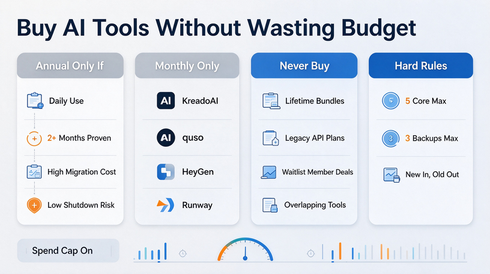
5.1 Valid Annual Plan Scenarios (Four Strict Conditions)
Only purchase annual subscriptions if all four conditions are met:
- The tool is core business infrastructure with daily high-frequency usage
- Two consecutive months of monthly usage prove positive ROI
- Mature workflows, team seats, and data accumulation create high migration costs
- Vendor is stable with no acquisition or shutdown risks
Safe annual plan examples: OpusClip Pro, Canva Pro, Notion Advanced, GitHub Copilot, ChatGPT Plus.
5.2 Monthly-Only Tool List
Never buy annual plans for KreadoAI, quso, Syllaby, HeyGen, Runway, Kling, Cursor/Devin, Munch, and Predis. Their credit rules, pricing structures, and features change constantly. Locking in annual plans forces you to absorb price hikes and value depreciation risks.
5.3 Strictly Prohibited AI Purchases
- Lifetime plans from unknown niche vendors (usually pre-bankruptcy inventory clearance)
- Expired API packages based on legacy models
- Beta founding member exclusive packages
- Three or more tools with fully overlapping functions
- Bundled plans charging premium fees for unused AI features
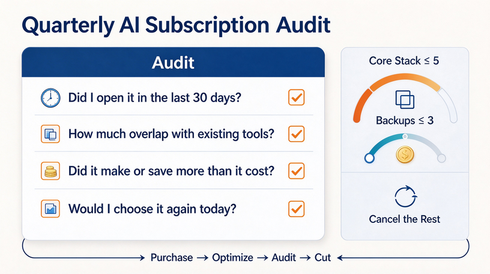
6. Regular Maintenance: Quarterly AI Subscription Audit Checklist
AI procurement is not a one-time purchase — it is ongoing asset management. Conduct a full tool-stack audit every 90 days using these four self-inspection questions:
- Has this tool been actively used in the past 30 days?
- How much functional overlap does it have with my existing tools?
- Does the value it creates or saves monthly exceed its subscription cost?
- Would I still choose this tool if rebuilding my workflow from scratch?
Two non-negotiable stack rules: Add one new tool, eliminate one old tool; cap core monthly tools at 5 and pay-as-you-go backup tools at 3.
7. Risk & Exit Strategy: Avoid Business Disruption From Vendor Changes
Watch for four critical vendor instability warning signs: unannounced price increases, hidden credit reductions, official acquisition announcements, weakened customer support, and forced API changes.
Every core tool needs a dedicated exit plan: pre-test reliable alternatives and build a complete data export workflow. Never store all core creativity and business data on a single third-party AI platform. Prioritize tools with unlimited API export access to eliminate vendor lock-in entirely.
8. Tool Stack Configuration for Different Team Sizes
8.1 Solopreneurs & Small Teams (1–3 People)
Keep your core stack lean: OpusClip, KreadoAI, Syllaby, quso.ai. Handle all automation via self-hosted n8n, and limit paid observation tools to 1–2 maximum.
8.2 Mid-Size Content Teams (5–15 People)
Deploy role-based team seats, enforce quarterly audits, and maintain independent backup accounts for video and AI avatar tools. Only purchase annual plans for fully stable, low-risk tools.
8.3 Enterprise Ad Teams (High Budget & Strict Compliance)
Add dual reviews for data residency and intellectual property before procurement. Build multi-layer vendor redundancy, and prohibit core client data storage on third-party AI platforms to eliminate compliance and operational risks.
9. Conclusion & Disclaimer
2026 AI tool purchasing is no longer about chasing the newest, most powerful features. It is about building a resilient business workflow that avoids constant system overhauls caused by vendor acquisitions, price hikes, and model phase-outs.
A high-quality AI content production system must be vendor-agnostic and dynamically adaptive. Your business should remain stable regardless of tool updates, price changes, or acquisitions. Building your tool stack around stability and ROI always outperforms chasing viral new AI tools.
Disclaimer: All pricing, tool status, and feature details in this article are accurate at the time of publication. The AI industry evolves extremely rapidly. Always verify the latest official terms, pricing, and service status before purchasing long-term subscriptions such as annual plans.
10. Appendix
10.1 Core Terminology Glossary
- Credits: Pay-as-you-go tokens for AI generation, video rendering, avatar production, and premium feature unlocking
- Self-Hosted: Software deployed on private servers instead of vendor cloud platforms, offering higher autonomy and security
- Model Layer: Underlying large language and video foundation models that power all AI tools
- Application Layer: End-user creative and operational AI tools built on top of foundation models
- AI Orchestration: Automated systems that connect multiple independent AI tasks into a complete end-to-end workflow
Disclosure: Some links on this page are affiliate links. We may earn a commission if you purchase through them — at no extra cost to you.
Was this review helpful?
Thanks for your feedback!